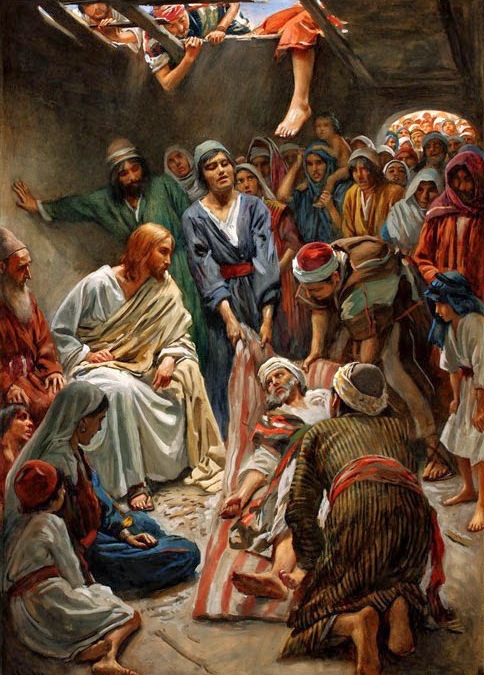
“Since they couldn’t bring him to Jesus because of the crowd, they made an opening in the roof over the place where he was. They dug through it and let down the mat on which the paralyzed man was lying.” [Mark 2:4]
Sometimes, doing the right thing is more complicated than it first appears. For example, digging a hole in the roof of someone else’s house—a huge hole, a hole big enough to lower an entire mattress through, easily falls into the “wrong thing” category. If you’re a rule-following type and you come across four guys digging a hole in someone’s roof, chances are you might yell up to them (or at least think in your head), “Hey! What are you doing? You can’t just make a hole in someone’s roof! That’s not your roof! Knock it off!” You would be upset that those four men weren’t following the basic rules of human consideration—one of them being that you can’t make huge holes in other people’s roofs.
In Mark 2:4, the Greek word translated as “removed” or “dug” means forcefully digging, gouging or removing an obstacle in order to achieve a particular goal. The roof was most likely made out of a mixture of straw and mud and would have been a clay-like consistency that had to be dug through. The four men who had transported their paralyzed friend to Jesus found the entrance to the house too crowded for them to push through. There was an obstacle between their friend and Jesus. Determined, they climbed the steps to the flat roof of the house and decided that the second obstacle, the roof, wasn’t going to keep them from getting their friend to Jesus’ feet.
And when the paralyzed man is delivered to Jesus, Jesus recognizes that the man’s paralysis isn’t the biggest obstacle in his life. Before Jesus heals his physical body, he tells the man, “Son, your sins are forgiven.” The man’s sin is his biggest obstacle—separating him from the goodness and presence of God. By telling him that he is forgiven, Jesus is first healing his heart and soul. Next, He heals the man’s physical body telling him to stand up, take his mat and walk.
What if removing the obstacles that stand between people and Jesus is the highest form of doing the “right” thing? What if it’s more important than all the other “right” things we believe we’re supposed to be doing? We live in a world where the “right” thing often involves performance and success—good grades, performance in a sport, a successful career, being a good person who follows all the rules and does what’s expected. Notice that Jesus isn’t upset with the men for digging a hole in the roof. Instead, it says that Jesus saw their faith. He wasn’t interested in them being “good” people, he was interested in them being people who had the faith to love each other well.
Later in Mark, when one of the Pharisees asks Jesus what is the most important commandment, He responds by saying, “Love the Lord your God with all your heart and with all your soul and with all your mind and with all your strength. The second is this: “Love your neighbor as yourself.” There is no commandments greater than these.” (Mark 12:30-31). In order to truly love the Lord with all that we are, we first have to allow Him to remove the obstacles that stand between us and Him—our sin, our shame, the lies we believe about who He is. Next, he begins to show us how to love the people around us the same way by helping to remove any obstacles that are separating them from the boundless love of God. Are we willing to become people who live and love radically? Are we willing to press pass the crowds, dig though roofs and risk looking like fools in order to bring people to Jesus’ feet? Are we willing to risk doing the wrong thing in the eyes of the world in order to do the right thing in the eyes of God?
There is a high cost to becoming a person who’s highest priority is bringing people to the feet of Jesus. We aren’t told in the story, but it ’s likely that the four men stayed to repair the roof after Jesus healed their friend.
Scripture Reference:
“And when he returned to Capernaum after some days, it was reported that he was at home. And many were gathered together, so that there was no more room, not even at the door. And he was preaching the word to them. And they came, bringing to him a paralytic carried by four men. And when they could not get near him because of the crowd, they removed the roof above him, and when they had made an opening, they let down the bed on which the paralytic lay. And when Jesus saw their faith, he said to the paralytic, “Son, your sins are forgiven.” Now some of the scribes were sitting there, questioning in their hearts, “Why does this man speak like that? He is blaspheming! Who can forgive sins but God alone?” And immediately Jesus, perceiving in his spirit that they thus questioned within themselves, said to them, “Why do you question these things in your hearts? Which is easier, to say to the paralytic, ‘Your sins are forgiven,’ or to say, ‘Rise, take up your bed and walk’? But that you may know that the Son of Man has authority on earth to forgive sins”—he said to the paralytic— “I say to you, rise, pick up your bed, and go home.” And he rose and immediately picked up his bed and went out before them all, so that they were all amazed and glorified God, saying, “We never saw anything like this!”” [Mark 2:1-12]
Discussion Questions:
1. Can you think of someone who paid a high price to get you to the feet of Jesus? What did it cost them?
2. What are some of the ways it might cost you to bring other people to Jesus’ feet, and is it worth it?
3. Is there a way that you’re preoccupied with doing the world’s “right” things instead of the right things of God—the things that actually bring people to the feet of Jesus?
4. Is there a specific person in your life who needs to be brought to the feet of Jesus? Gods probably not going to ask you to cut a hole in someone’s roof, but it might cost you. Can you imagine what the cost for that person might be?