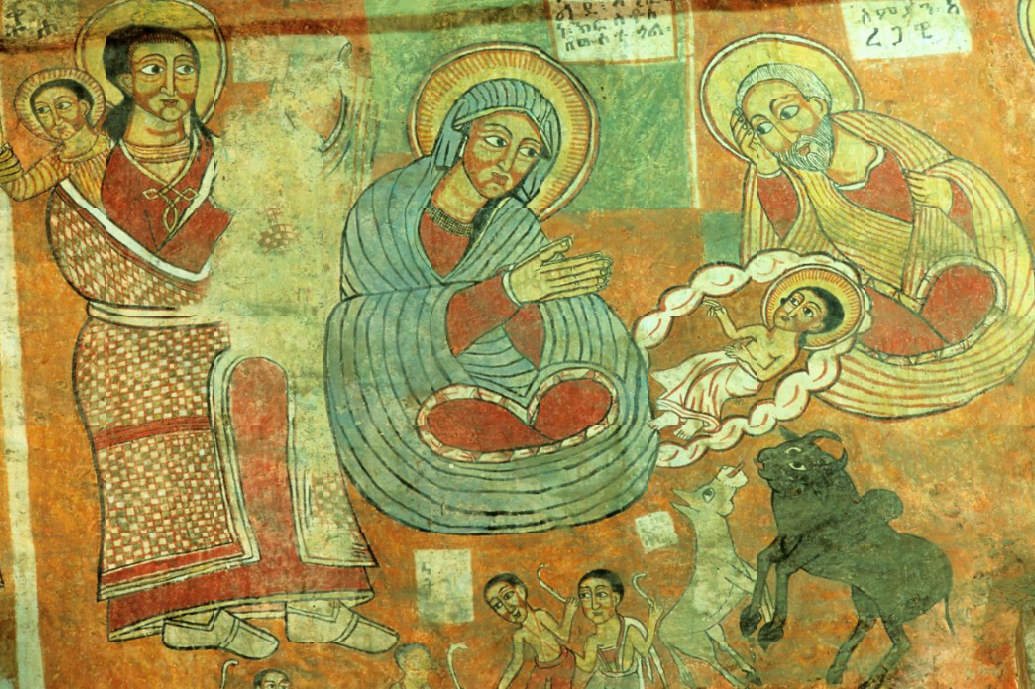
“And she gave birth to her firstborn son and wrapped him in swaddling cloths and laid him in a manger, because there was no place for them in the inn.” [Luke 2:7 ESV]
If you’ve ever watched a home show where an old house was being renovated, you’ve probably encountered a scene or two where the renovators discover a beautiful wood floor buried beneath layers of crusty carpet or an incredible fireplace covered up with drywall. The story of Jesus’ birth is sort of like a beautiful old floor or fireplace that’s been covered in gunk through the centuries. There’s a whole lot of myth and legend that have been added to our understanding of the story. It might be time to peel back the layers and see what’s really there in the biblical narrative. Spoiler alert, most of what we think of when we picture Jesus’ birth comes from a story written by a non-Jewish, European Christian 200 years after Jesus was born. The author didn’t really have a sense of Middle Eastern customs, so, he just made a bunch of stuff up, and it really stuck.
For starters, there was no room in the inn? What inn? The greek word commonly translated as an “inn” in Luke’s narrative (Luke 2:7) is translated as guest room or upper room in other parts of the gospels (see Luke 22:11). The Romans built inns along major roads and in major cities, but not in villages like Bethlehem. And even if there was an actual inn, Joseph and Mary were not among the wealthy people who could have afforded to stay in one. So, what did Luke mean when he wrote that there was no room in the inn? Luke was telling his readers that the guest room or the upper room in the house where Joseph and Mary were staying was already full of people. It was a packed house. So the young family was either sharing the main room with the family or they were staying in the lower part of the house where a few small animals were brought in at night.
That’s where the manger comes in. Only the wealthy could afford to build separate shelters for their animals. The vast majority of people at this time would have kept a few goats or sheep for milk and wool and brought them into their houses at night for safekeeping. There would have been a small section either at the back of the house or on a lower floor for the animals with a low, half-wall to keep them contained. Small feeding troughs or mangers were built into the top of the wall so the animals could easily be fed each night. By telling us about the manger, Luke wasn’t telling us that Jesus was born in a barn or a cave, he was saying that He was born in the section of the house near where the animals were kept—that’s how full the house was that night.
Most likely, the house where they were staying belonged to Joseph’s relatives—Bethlehem was his hometown after all. We are told that he was of the lineage of David. We’re also told that Bethlehem was called “the City of David.” Even though he was poor, Joseph would have been an honored guest in any house in Bethlehem because he was from the royal line of David, and this was David’s city. On top of that, it would have been unheard of and deeply dishonorable for a Jewish village to turn away a Jewish woman in the distress of childbirth. The common depiction of Joseph hurrying into town at night with Mary going into dramatic labor on the back of a donkey is kind of a problem too. Luke tells us that they were already in Bethlehem when the time came for the birth. Luke 2:6 says, “while they were there, the time came for her to give birth.” They had plenty of time to make arrangements. Mary’s cousin, Elizabeth, was only a few miles away. Mary had recently been at her cousin’s house and could have easily gone back if she didn’t have anywhere to give birth in Bethlehem. As steeped as we are in images of Joseph going door to door, turned away over and over again until he took his wife to a barn, it’s just not in the Bible.
When Luke wrote the story of Jesus’ arrival, he was writing to an Eastern audience. He was writing to people who knew what the average house was like, people who knew about guest rooms and Middle Eastern hospitality. They knew it would have been a whole lot more likely for Joseph and Mary to find shelter in a welcoming home with relatives than in a wealthy man’s barn. The details of Jesus’ birth were a lot more common than we’ve been led to believe by the legends we’ve inherited. Jesus entered on the scene in a common house, in a common village, surrounded by common people, like any other baby at the time. It’s against the backdrop of the common and the very ordinary nature of His birth that we can truly grasp the extraordinary reality that was unfolding. It wasn’t that He was born in a barn or a cave or surrounded by animals, that’s not the exceptional part. If we quiet all the mythical noise and zero in on the true miracle of the moment, we can hear all of creation catch it’s breath as the God of heaven and earth strains His blood-soaked, naked body and pierces the ears of ordinary listeners with His first cry. Heaven has come to earth, God is with us.
Scripture Reference:
“And Joseph also went up from Galilee, from the town of Nazareth, to Judea, to the city of David, which is called Bethlehem, because he was of the house and lineage of David, to be registered with Mary, his betrothed, who was with child. And while they were there, the time came for her to give birth. And she gave birth to her firstborn son and wrapped him in swaddling cloths and laid him in a manger, because there was no place for them in the inn. And in the same region there were shepherds out in the field, keeping watch over their flock by night. And an angel of the Lord appeared to them, and the glory of the Lord shone around them, and they were filled with great fear. And the angel said to them, “Fear not, for behold, I bring you good news of great joy that will be for all the people. For unto you is born this day in the city of David a Savior, who is Christ the Lord. And this will be a sign for you: you will find a baby wrapped in swaddling cloths and lying in a manger.” And suddenly there was with the angel a multitude of the heavenly host praising God and saying, “Glory to God in the highest, and on earth peace among those with whom he is pleased!” When the angels went away from them into heaven, the shepherds said to one another, “Let us go over to Bethlehem and see this thing that has happened, which the Lord has made known to us.” And they went with haste and found Mary and Joseph, and the baby lying in a manger. And when they saw it, they made known the saying that had been told them concerning this child. But Mary treasured up all these things, pondering them in her heart. And the shepherds returned, glorifying and praising God for all they had heard and seen, as it had been told them.”
Luke 2:4-17, 19-20 ESV
Discussion Questions:
1. What if not everything you have heard about the stories in the Bible is true? Do you think you may have some beliefs that you’ve inherited that aren’t actually written in the Bible?
2. How do we make sure that the Bible is our first source for understanding what the Bible teaches and who Jesus is instead getting our ideas from other resources?
3. If you were to write the story of the Almighty God becoming a human, how would you write it? Would you imagine Him showing up as a commoner, as a baby? Or would it look a little more like Aladdin’s grand entrance?
4. What does it mean that the God of all Creation chose to come to Earth the way He did? Why does it matter?