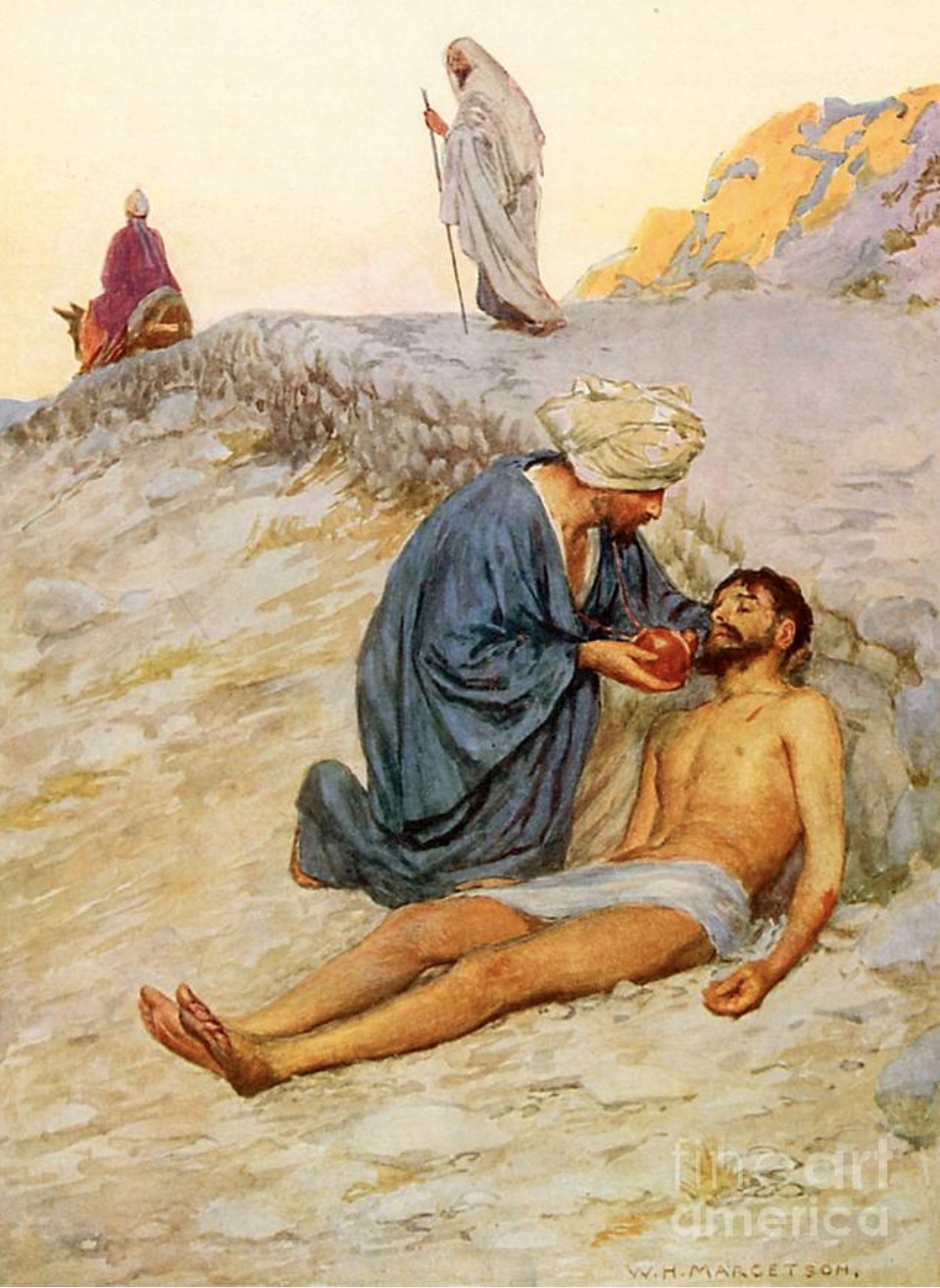
“A man was going down from Jerusalem to Jericho, and he fell among robbers, who stripped him and beat him and departed, leaving him half dead.” Luke 10:30
This is a love story, the best kind of love story. But it’s not what you’re thinking. It’s the story of a man who loves his enemy in a way that is extravagant and extremely costly. And the crazy part is, the whole time, his enemy is unconscious. We don’t even know if this unconscious man would be grateful for the help he was receiving. Maybe he would even wake up and, seeing that this man belonged to an enemy tribe, spit in his face. And yet, the Samaritan in the story choses to love this unconscious Jewish man in a way that is exceedingly beautiful—he gives his time, his resources, money and risks his life to help a man who can give him absolutely nothing in return. But these two men aren’t the only ones in the story. There are others who also love. But, theirs is a different kind of love. Their love is not for people, their love is for the religious law. They love the law so much that it actually prevents them from loving their neighbors.
The parable of the Good Samaritan is a story within a story. This story begins with a religious law expert (sometimes called a lawyer) asking Jesus a question to test Him. As Jesus so often does, He redirects the conversation until the man asks the right question, which Jesus ultimately answers with a story. The first question he asks Jesus is what he has to do to inherit eternal life. Basically, he’s asking, “what do I have to do to make sure I get what’s coming to me?” The funny thing about his question is that an inheritance isn’t something you can earn. An inheritance is something you receive because you are your father’s child, you’re a part of the family. The question that Jesus ultimately directs him to is “Who is my neighbor?” This is a very different kind of question. This is a question that asks, “how do I behave like one of my Father’s children?” Here’s the thing: this means that you have to know your Father. You have to know what He’s like, loving what He loves, doing what He does.
Jesus tells a story to explain to the man and to all His listening disciples what His Father is like. He starts by giving a couple of examples of what His Father is not like. The examples he gives are of men who everyone would have thought of as the “good” people, these are the men the audience would have expected to be the heroes of the story. The first is a Jewish priest who was likely on his way home from serving his two weeks in the temple when he came upon the naked and unconscious man. There were a lot of laws governing the priest’s behavior and obligation to help those in need. He was obligated to help his fellow Jews. But, since this guy was naked and unconscious, it was impossible for him to know if he was a Jew or not. It was a terribly complicated situation for him. For example, if the man was dead and the priest touched him, he would have to return to the temple in Jerusalem and go through a week long cleansing process. Very inconvenient. The Levite who came along after the priest is another example of a “good” person who doesn’t reflect what the Father is like. The Levite may have been the priest’s assistant, he was a man under the priest’s authority. And if he decided to help a man who the priest passed by, it had the potential to make the priest look really bad. Who was he to overstep a priest?
Finally, Jesus tells of the most unlikely person to come offer help. A Samaritan! As He told this story, Jesus and His disciples were walking through Samaria on their way to Jerusalem and they had already had some bad encounters with Samaritans. The Jews and Samaritans had a feud that went back hundreds of years, a feud that often turned violent. So, a story where the Samaritan was the hero would have made Jesus’ audience really, really uncomfortable, even angry. Yet, this is the story Jesus tells to explain what His Father is like. His Father is like a man who stops to help a fellow human in need, a man who can offer absolutely nothing in return. He pays a great price to help this man.
First, who knows if the robbers are still around? The seventeen mile road from Jerusalem to Jericho winds through a valley with hillsides full of caves. Were the robbers waiting around to rob the first person who stopped to help this man? Stopping was a risk. He spends his time and uses his supplies to treat the man’s wounds—cloth, olive oil and wine were all valuable resources. And then he heaves this guy, covered in nothing but wounds, up onto the back of his donkey and walks him into Jericho, where the nearest inn would have been. Because it was a Jewish town, Jericho was not a town where a Samaritan would want to show up with a wounded and unconscious Jewish man. Again, he was taking a great risk to help this man. Finally, he pays the inn keeper the equivalent of two days’ wages (hundreds of dollars in today’s economy) and promises to cover any more expenses if needed.
After He finishes telling the story, Jesus slightly rewords the man’s question. Jesus asks him, “which of these three do you think proved to be a neighbor?” Jesus isn’t interested in ideas, He’s interested in action. Which of the three men actually loved his neighbor? It was the man who chose the highest form of love, a love that says to it’s neighbor, “your good at my expense.” This is true love. When we love this way, we are showing the watching world what our Father is like. If you want to look like your Father, spend time with Him, get to know Him and allow His love to overwhelm you. In return, you might just find yourself falling in love with Him. We will all become more and more like what we most love.
Scripture Reference:
“On one occasion an expert in the law stood up to test Jesus. “Teacher,” he asked, “what must I do to inherit eternal life?” “What is written in the Law?” he replied. “How do you read it?” He answered, “ ‘Love the Lord your God with all your heart and with all your soul and with all your strength and with all your mind’; and, ‘Love your neighbor as yourself.’” “You have answered correctly,” Jesus replied. “Do this and you will live.” But he wanted to justify himself, so he asked Jesus, “And who is my neighbor?” In reply Jesus said: “A man was going down from Jerusalem to Jericho, when he was attacked by robbers. They stripped him of his clothes, beat him and went away, leaving him half dead. A priest happened to be going down the same road, and when he saw the man, he passed by on the other side. So too, a Levite, when he came to the place and saw him, passed by on the other side. But a Samaritan, as he traveled, came where the man was; and when he saw him, he took pity on him. He went to him and bandaged his wounds, pouring on oil and wine. Then he put the man on his own donkey, brought him to an inn and took care of him. The next day he took out two denarii and gave them to the innkeeper. ‘Look after him,’ he said, ‘and when I return, I will reimburse you for any extra expense you may have.’ “Which of these three do you think was a neighbor to the man who fell into the hands of robbers?” The expert in the law replied, “The one who had mercy on him.” Jesus told him, “Go and do likewise.”” Luke 10:25-37 NIV
Discussion Questions:
1. What are some of the things that prevent us from loving our neighbors? Is it easy to exclude some people from the “neighbor” category in your mind?
2. Can you think of a time when you passed up an opportunity to be a neighbor to someone? Take some time to ask yourself why.
3. Who are we becoming more and more like? What does that reveal about what we love most? Spend sometime journaling through this question. Think about where you spend most of your time and resources on? Look at your screen time average, ask the people around you. Pray and ask the Lord.