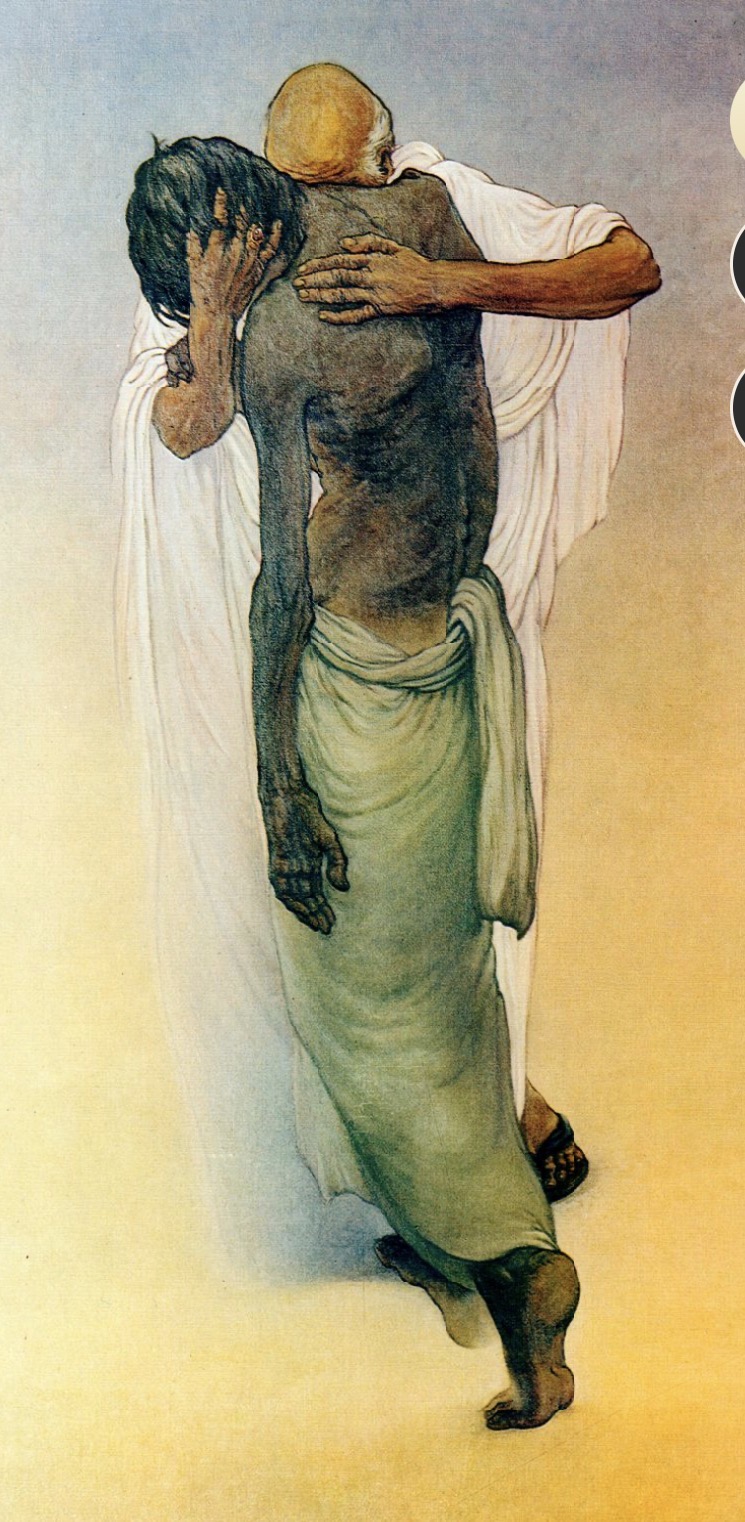
‘A man had two sons. The younger of them said to his father, “Father give me the share of the estate that is coming to me.” And so he divided his wealth between them.’ Luke 15:11
This story, often called the story of the Prodigal Son, is one story in a series of “Lost and Found” stories that Jesus tells to a group of Pharisees. The Pharisees are grumbling at Jesus because of his habit of eating with sinners. In the ancient Near East, sharing a meal with someone meant that you accepted them. The Pharisees weren’t okay with Jesus‘ acceptance of sinners. They didn’t accept sinners, and they didn’t think Jesus should either.
Jesus’ “Lost and Found” stories include the story of a lost sheep, the story of a lost coin and the story of two lost brothers (the Prodigal Son story). There’s a pattern that repeats itself in each of the stories – something valuable is lost, it is searched for and found, and there is a celebration once it is found. This week, we are looking at the story of the lost younger brother. Next week, we will look at the story of the lost older brother. Jesus’ “Lost and Found” stories are stories we can all identify with. We have all felt the ache of losing something dear to us, the anxious search and the joyful celebration of finding what was lost.
The first two stories are fairly simple. The third story unfolds with much more detail. The story begins with a young man, the youngest of two brothers, demanding his inheritance from his father. To Jesus‘ audience, this sort of demand would have been absolutely unheard of. By asking for what he would have received after his father‘s death, the young man was essentially saying that he wished his father was dead. This was deeply dishonoring to his father and, by extension, to the entire community. The expected response would have been for the father to beat his son and turn him out, never to speak to him again. But Jesus is telling the story of a different kind of father, a story that represents His heavenly Father.
The inheritance that the son demanded wasn’t a pile of gold that the father could simply hand over. The father‘s wealth, the son‘s inheritance, was in the very land the family inhabited. It’s difficult for us to comprehend how deeply shameful it would have been for the father to sell off one-third of his land (the younger brother‘s portion). This was ancestral land, land that had been handed down in his family for countless generations, land that defined the family identity, land that connected them to their tribe in their community, land that’s worth would be hard to measure out in gold. After the father paid such a high price to liquidate his land and handed over to his son, the young man quickly wasted every last ounce of it, throwing away a priceless generational inheritance on pleasure that quickly evaporated.
We are told that the young man went to a distant country where he squandered his estate in wild living. Eventually, he finds himself starving and longing for his far off home. He advises a plan to beg his way back into his father‘s household, and begins the long journey home. As he trudges his way home, barefoot, with worn out clothes and an empty belly, he is undoubtedly rehearsing the words he will use to beg for mercy from the father he has so unforgivably dishonored.
What he doesn’t know, is that since the day he left, the father has been scanning the horizon, longing for the return of his lost son. Even in his ragged and emaciated state, the father recognizes his son while he is still a long way off. Once again, the father does something unheard of and deeply dishonorable for his son—he gathers up his robes, bearing his legs like a child and takes off running down the road toward his astonished son.
Before the young man can even get his whole rehearsed apology out, the father wraps him in his arms and covers him with kisses and tears. He sends for his own best robe and his signet ring. He put shoes on his feet and plans a huge feast. He wants the whole community to celebrate with him that his lost son is home safe.
This is the story Jesus tells to explain to the Pharisees what His Father is like. His father is like a man who pays a great price and endures great shame and dishonor in order to love his wayward children. This is why Jesus extends love and acceptance to sinners—sinners who know they are like the lost son and are overwhelmed with gratitude to be welcomed home. This story is for all of us, we have a Father who scans the horizon, ready to run out and meet us, to wrap us in His arms and cover us with His love the moment we turn and begin our journey home.
Scripture Reference:
“Jesus continued: “There was a man who had two sons. The younger one said to his father, ‘Father, give me my share of the estate.’ So he divided his property between them. “Not long after that, the younger son got together all he had, set off for a distant country and there squandered his wealth in wild living. After he had spent everything, there was a severe famine in that whole country, and he began to be in need. So he went and hired himself out to a citizen of that country, who sent him to his fields to feed pigs. He longed to fill his stomach with the pods that the pigs were eating, but no one gave him anything. “When he came to his senses, he said, ‘How many of my father’s hired servants have food to spare, and here I am starving to death! I will set out and go back to my father and say to him: Father, I have sinned against heaven and against you. I am no longer worthy to be called your son; make me like one of your hired servants.’ So he got up and went to his father. “But while he was still a long way off, his father saw him and was filled with compassion for him; he ran to his son, threw his arms around him and kissed him. “The son said to him, ‘Father, I have sinned against heaven and against you. I am no longer worthy to be called your son.’ “But the father said to his servants, ‘Quick! Bring the best robe and put it on him. Put a ring on his finger and sandals on his feet. Bring the fattened calf and kill it. Let’s have a feast and celebrate. For this son of mine was dead and is alive again; he was lost and is found.’ So they began to celebrate.”
Luke 15:11-24 NIV
Discussion Questions:
1. What do you think the younger brother was looking for in the distant country? Belonging, meaning, acceptance, wealth, power? What are you seeking?
2. Is there any part of you that struggles to believe that the Father scans the horizon for you and would run out to meet you when you come home?
3. Can you look back and see the way your Heavenly Father, with patience, enduring great shame and dishonor has paid a great cost to see you His son/daughter return home?
Assignment:
Read all of Luke 15. Answer in your journal these questions as you read:
– Why did Jesus eat, sit and welcome sinners.
– Why do religious people reject those that Jesus came to love?
– What is Jesus telling through these three parables about who we are and who he’s calling us to love?