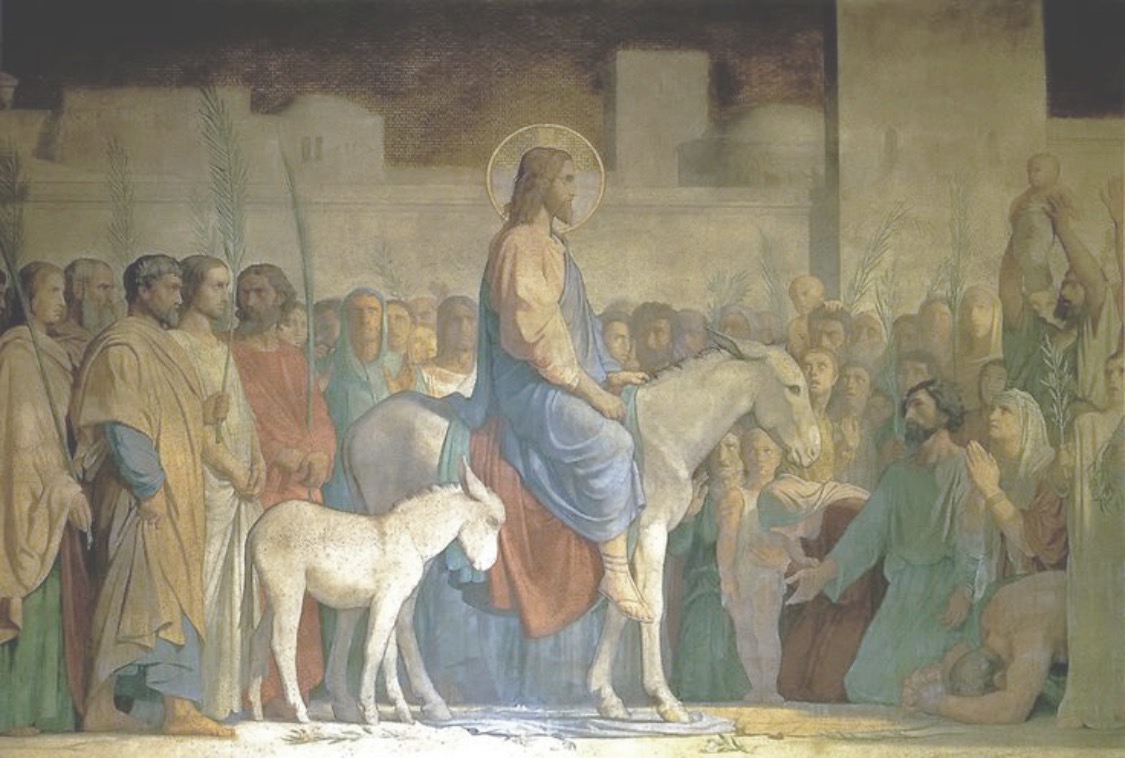
“Rejoice greatly, Daughter Zion! Shout, Daughter Jerusalem! See, your king comes to you, righteous and victorious, lowly and riding on a donkey, on a colt, the foal of a donkey.” [Zechariah 9:9]
Throughout His ministry on earth, Jesus was deeply engaged in teaching His followers. Sometimes He taught with words—in His parables and in the Sermon on the Mount, for instance. At other times, Jesus taught with His life—by living out a reality that He wanted His followers to understand by seeing rather than by hearing. Jesus’ triumphal entry into Jerusalem is one of those instances.
In order to better understand what Jesus was communicating as He rode a young donkey towards Jerusalem, we need a little context. There are historical realities that would have shaped the understanding of those watching. For one, the Jewish scriptures were full of prophesies of a Messiah that would come to rescue Israel from its oppressors and establish a new Jerusalem. We see this in this week’s passage from Zechariah. For centuries, Jew’s had waited in hope for a savior who would save them from their oppressors and set up a political kingdom in Jerusalem. When Jesus arrived on the scene and His life began to fulfill the prophesies, many held their breath hoping that He was coming to conquer Rome and become an earthly king.
Another piece of the historical framework is the Maccabeean Revolt, which took place around 200 years earlier. In 167 B.C. Jerusalem and the temple had been taken over by a pagan Greek king. The Maccabees, a religious military family rallied resistance fighters to overthrow their oppressors. After a struggle that lasted several years, they were victorious and won independence for Israel. When the Maccabees returned to Jerusalem, crowds of people celebrated their conquering heroes by waving palm branches and shouting praises. The Jewish holiday, Hanukkah is connected to this victory and it’s still remembered and celebrated to this day. Jesus’ followers were watching to see if He was going to spark another revolt and rescue Israel from the oppressive Roman occupiers in the same way the Maccabees had.
And this leads us to another bit of history that will help you understand Jesus’ actions. During the time Jesus was alive and in the early days of Christianity, the Romans loved to celebrate their battle victories. Generals who won major victories were often celebrated with a Roman Triumph. A Roman Triumph was a public display of military might in which the celebrated general would ride into the city (usually Rome) on a chariot pulled by four war horses. The spoils of war and the captives would be paraded through the streets behind him. The general would wear a victory wreath on his head and be clothed in a purple and gold robe. His face was often painted red in recognition of the Roman god Jupiter. The general would achieve god-like status for the day and the parade would end at Jupiter’s temple where the general would offer sacrifices. Although these parades usually happened far away in Rome, Israel was a Roman province during Jesus’ lifetime and aspects of these same type of displays of power and military might echoed throughout the provinces of Rome. Some historian think that the Roman governor, Pontius Pilate, may have been entering into the other side of Jerusalem at the same time that Jesus was riding in on His donkey. Pilates’ entry would have been a display of power and intimidation—aimed to keep the peace in Jerusalem as large crowds gathered for the Passover Feast.
Against the remembered backdrop of military parades and prophetic predictions, Jesus is making a clear statement about a different kind of kingdom. He comes in humility, not pride. He comes in gentleness rather than human strength. He rides in on a donkey, not a warhorse. He approaches the city with tears streaming down His face, not with a countenance of prideful intimidation. His weapon of victory is the cross, not a sword. He declares the victory before the battle, not after—all authority is His. Like the Roman general, Jesus’ procession would ultimately end in sacrifice. But, rather than a human making a sacrifice to man-made god, this was the one true God sacrificing Himself on behalf of all humanity. His followers were expecting a different kind of king, a different kind of kingdom. As He rode in, He was proposing that there is another way. And He was asking His followers to decide which king and what kingdom they wanted to belong to.
Throughout His last week on earth, Jesus would continue to teach His followers and all the watching world through lived examples. He would do this by turning tables, washing feet, breaking bread, pouring wine and then pouring out His life for us on the cross. Where the Roman general wore a crown of laurel vines, Jesus wore a crown of thorns. Where the Roman general was honored with a purple robe, Jesus was mocked with a red robe. The Roman general painted his face red—Jesus’ face was stained with His own blood. Where the Roman general was called god for a day, Jesus showed Himself to be the God of all Creation when He stepped out of the grave and into the ultimate victory, inviting us to join Him in a life of triumphal procession over death.
Scripture Reference:
“And when he had said these things, he went on ahead, going up to Jerusalem. When he drew near to Bethphage and Bethany, at the mount that is called Olivet, he sent two of the disciples, saying, “Go into the village in front of you, where on entering you will find a colt tied, on which no one has ever yet sat. Untie it and bring it here. If anyone asks you, ‘Why are you untying it?’ you shall say this: ‘The Lord has need of it.’” So those who were sent went away and found it just as he had told them. And as they were untying the colt, its owners said to them, “Why are you untying the colt?” And they said, “The Lord has need of it.” And they brought it to Jesus, and throwing their cloaks on the colt, they set Jesus on it. And as he rode along, they spread their cloaks on the road. As he was drawing near—already on the way down the Mount of Olives—the whole multitude of his disciples began to rejoice and praise God with a loud voice for all the mighty works that they had seen, saying, “Blessed is the King who comes in the name of the Lord! Peace in heaven and glory in the highest!” And some of the Pharisees in the crowd said to him, “Teacher, rebuke your disciples.” He answered, “I tell you, if these were silent, the very stones would cry out.” And when he drew near and saw the city, he wept over it,”
Luke 19:28-41 ESV
Discussion Questions:
1. When someone decides to become a citizen of a new country, they have to give up all their rights as citizens of their old country. What are some of the rights we have to give up as we become citizens of heaven?
2. Read 2 Corinthians 10:4 What are the weapons of warfare that we use as citizens of heaven?
3. Have you made a decision about what king and what kingdom you want to belong to?