John 20:11
“But Mary stood weeping outside the tomb, and as she wept she stooped to look into the tomb.”
There’s a funny moment in this story when Mary mistakes Jesus for a gardener. It seems funny anyway. But the bit about Mary thinking Jesus is a gardener isn’t an irrelevant detail. John intentionally included this in his retelling of the resurrection story because he knew it was important. And it is. The reason Mary thought Jesus was a gardener was because the tomb where Jesus was buried was in a garden. When Jesus stepped out of the tomb and into His resurrected life, He stepped out into a garden. This is not just a biographical detail. This is central to the story.
As we saw last week, Jesus entered into His suffering and death through the garden of Gethsemane. After He was crucified and died, He stepped out of a tomb and into a garden. The idea of the garden is foundational to our human story. We see at the beginning of Genesis that a garden was God’s ultimate plan for the place where mankind and God would dwell together. The garden represents the place where the human and divine commune. After mankind fell and was expelled from the garden, the temple became the new place where humans could dwell with God. Solomon’s temple was designed to resemble a garden. The walls, pillars and furnishing were decorated with palm trees, pomegranates, gourds, lilies, almond blossoms, and flowers. The temple was like a miniature Eden—but it was a place that required following a complicated set of rules and offering continual sacrifices to gain limited access to the presence of God. The temple was a temporary solution, while the world waited for a Savior who would rescue them and whose sacrifice would make a way for them back into God’s presence once and for all.
And that’s what happened when Jesus defeated sin and death and emerged from the tomb. His death and resurrection means that all of creation is reconciled to its Creator God. Jesus opens the way back into the garden presence of the Father—Jesus is the doorway. His resurrection doesn’t mean that we get to go to heaven when we die, His resurrection means that heaven comes down to earth here and now, in the midst of our broken lives. It means that Jesus, the gardener, is now with us through the Holy Spirit, cultivating Eden in the very dust of our flesh.
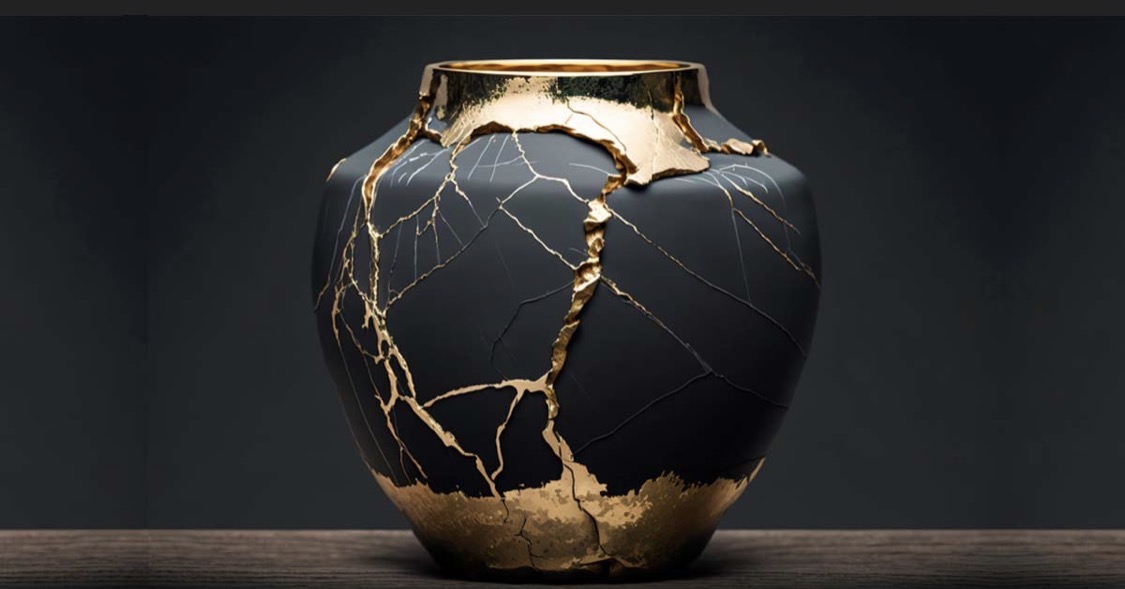
And here’s the thing about well-tended gardens; well-tended gardens grow and spread. They produce fruit that drops seeds, resulting in more life and more seeds. They grown into barren and desolate places and fill them with new life. In Revelation 21:5 we hear Jesus say, “Behold, I am making all things new.” This “new” that Jesus talks about is a new kind of new. It’s not just a new that takes us back to square one. It’s a new that’s even better than the original. The ancient Japanese art of kintsugi explains this kind of newness. In kintsugi, a ceramic artist takes a broken vessel and mends it by filling the cracks with gold. The finished product is no longer just a vessel, it has become a work of art. And this is the significance of Jesus’ death and resurrection. He chose to pour out His life in order to take all that we have shattered, all of broken creation, and make it new.
Somehow, in His infinite goodness and perfection, God takes our brokenness and the mess we made and makes it even better than it was before we broke it. This is the miracle of the resurrection—that God weaves the broken threads into our story in such a way that it is more beautiful and whole in its restored state than it ever was before. How can this be? Only by the blood of Jesus.
Today, when you hear Him call your name, as He called out to Mary, respond the same way she did. Cry out to Him and invite Him into your life. Invite Him to begin tilling the soil of your broken flesh and to begin cultivating a beautiful flourishing life that will spill over into all the barren and empty spaces around you, and in all the lives you touch. This is the resurrected life.
Scripture Reference:
“But Mary stood weeping outside the tomb, and as she wept she stooped to look into the tomb. And she saw two angels in white, sitting where the body of Jesus had lain, one at the head and one at the feet. They said to her, “Woman, why are you weeping?” She said to them, “They have taken away my Lord, and I do not know where they have laid him.” Having said this, she turned around and saw Jesus standing, but she did not know that it was Jesus. Jesus said to her, “Woman, why are you weeping? Whom are you seeking?” Supposing him to be the gardener, she said to him, “Sir, if you have carried him away, tell me where you have laid him, and I will take him away.” Jesus said to her, “Mary.” She turned and said to him in Aramaic, “Rabboni!” (which means Teacher). Jesus said to her, “Do not cling to me, for I have not yet ascended to the Father; but go to my brothers and say to them, ‘I am ascending to my Father and your Father, to my God and your God.’” Mary Magdalene went and announced to the disciples, “I have seen the Lord”—and that he had said these things to her. On the evening of that day, the first day of the week, the doors being locked where the disciples were for fear of the Jews, Jesus came and stood among them and said to them, “Peace be with you.” When he had said this, he showed them his hands and his side. Then the disciples were glad when they saw the Lord.” John 20:11-20 ESV
Discussion Questions:
1. Imagine your life like a vessel, shattered and broken because of your bad decisions and the sin of others. Can you imagine your life being more beautiful put back together after sin and death because of the power of the resurrection of Christ?
2. Is your life like a well-tended garden vine that spreads, produces fruit and reproduces that fruit in others? If not what would need to happen first for that to become your reality? (Read John 15:1-11 for help)
3. If Jesus is the doorway into relationship with the Creator God, have you stepped through the doorway from death into life? If not, would you like to do that today? (Romans 10:9 will help you with that)
Assignment:
Read through the Message translation of Colossians 1:18-21 and write down in your journal what it means for your life.
“Not only that, but all the broken and dislocated pieces of the universe -people and things, animals and atoms- get properly fixed and fit together in vibrant harmonies, all because of his death, his blood that poured down from the cross.” Colossians 1:18-21