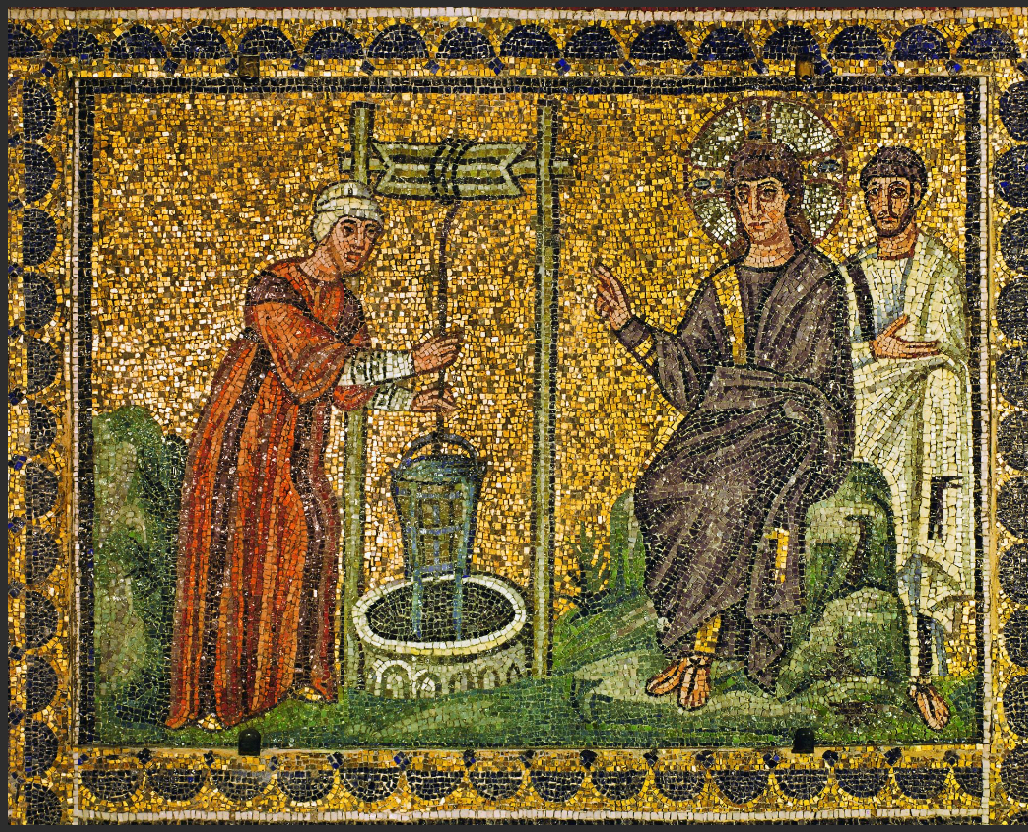
So Jesus, wearied as he was from his journey, was sitting on the well. It was about the sixth hour. A woman from Samaria came to draw water. Jesus said to her, “Give me a drink.” John 4:6-7
Everything about this story is completely wrong. Jesus wasn’t supposed to be in Samaria, He wasn’t supposed to be talking to a woman and He really wasn’t supposed to be talking to a Samaritan woman. And that’s not even the worst part. Jesus drank out of her cup! Her! A filthy Samaritan woman! While the rest of the respectable Jews were following the well-worn path around Samaria, John 4:4 tells us that “Jesus had to pass through Samaria.” Why? Sure, it was the shortest path to Galilee, where He was headed, but no one went through there. His disciples would never have been caught dead in Samaria. But, Jesus had to go there. Partly because He was seeking out an overlooked woman, and partly to call an entire outcast people group back into the family of God.
The Jews and the Samaritans had a long, complicated conflict that had its roots in the time of exile centuries earlier. The Jews saw the Samaritans as half-breeds, traitors and people who had corrupted the holy scriptures. And women? Women were seen as property and their highest purpose was to bring honor to their husbands by birthing sons. The Jewish Rabbis who lived before Jesus had established that women were not to be trusted, they gave rise to shame and reproach, and daughters were a disaster and a liability. A respectable Jewish Rabbi wouldn’t even speak to his own wife in public. And here we find Jesus, in the middle of the despised land, talking to a member of the despised gender.
The first thing Jesus does is something completely human, but something that completely shocks the woman. He is thirsty and He asks her for a drink. Middle Eastern wells didn’t have buckets, people carried their own leather buckets that they could roll up and take with them. By asking to drink from her bucket, Jesus showed deep vulnerability and dignified the woman. He is the God of all Creation, there were an unlimited number of ways He could have used His power to get water from the bottom of the well. Instead, He humbled Himself and asked for help from an outcast woman, helping to empower her by seeing that she had something to offer rather than always being the one in need of other people’s charity. And Jesus was always doing this. He was never the guy with the big house and all the cool stuff who ministered from a position of wealth and power. He was the poor guy who was always in need of someone else’s hospitality. The God of all Creation showed up on the scene humble and vulnerable so He could show us how to need each other and build healthy communities where we depend deeply on one another.
Rather than engaging in small talk, Jesus and the woman have a long and deeply theological conversation. And while we don’t have the space here to discuss all the details of the theology, there are a few points we don’t want to miss. First, we need to understand what it means that the woman had been married five times and was now living with a man who wasn’t her husband. In the Middle East, it would have been extremely rare for a woman to be granted a divorce, let alone five divorces. Men, on the other hand, could divorce their wives if they “no longer found them favorable.” One reason a woman was “unfavorable” was if she was barren. A woman who couldn’t have children was seen as a curse and that curse would have been extended to her husband. We aren’t given the details of why the woman had been through so many marriages—she may have been widowed, or barren, maybe her babies were stillborn—and man after man had sent her packing. Also, it was impossible for a woman to survive on her own as a widow and even more so as a divorced woman. So she was most likely making survival decisions out of desperation. It is interesting to note that Jesus didn’t tell her to “sin no more” as he did with another woman caught in adultery. And we don’t see the woman repent before Jesus. There is no doubt that the situation she is in is a source of deep shame, but we don’t know from the text if the source of her shame is sin or a heartbreaking and powerless situation. What we do know is that Jesus saw her and got right to the heart of it. He told her that He knew all about her sad story, she didn’t have to hide it from Him.
Not only was He willing to engage with her in the shame of her past, Jesus invited her into a beautiful new place of honor in her community and in the Kingdom of God. He revealed to her—the woman with three strikes against her—that He was the Messiah. This was huge. She was the first person He revealed this to. And then, even crazier, He sent her, a woman, out to go tell the people of her community that the Messiah had come. John 4:39 tells us that, “Many Samaritans from that town believed in Him because of the woman’s testimony.”
Jesus asked the woman for a drink, and in turn, He offered her the living water of new life. Then, He showed her how the living water would become a spring flowing out of her life to the people around her. He’s still doing the same thing today. He continually crosses into the shameful areas of our culture and our lives to let us know that He’s near and He sees us. And if we will let Him, He will satisfy our deepest longings and cause rivers of living water to flow out of our lives to the hurting people around us.
Scripture Reference:
“And he had to pass through Samaria. So he came to a town of Samaria called Sychar, near the field that Jacob had given to his son Joseph. Jacob’s well was there; so Jesus, wearied as he was from his journey, was sitting beside the well. It was about the sixth hour. A woman from Samaria came to draw water. Jesus said to her, “Give me a drink.” (For his disciples had gone away into the city to buy food.) The Samaritan woman said to him, “How is it that you, a Jew, ask for a drink from me, a woman of Samaria?” (For Jews have no dealings with Samaritans.) Jesus answered her, “If you knew the gift of God, and who it is that is saying to you, ‘Give me a drink,’ you would have asked him, and he would have given you living water.” The woman said to him, “Sir, you have nothing to draw water with, and the well is deep. Where do you get that living water? Are you greater than our father Jacob? He gave us the well and drank from it himself, as did his sons and his livestock.” but whoever drinks of the water that I will give him will never be thirsty again. The water that I will give him will become in him a spring of water welling up to eternal life.” The woman said to him, “Sir, give me this water, so that I will not be thirsty or have to come here to draw water.” Jesus said to her, “Go, call your husband, and come here.” The woman answered him, “I have no husband.” Jesus said to her, “You are right in saying, ‘I have no husband’; for you have had five husbands, and the one you now have is not your husband. What you have said is true.” The woman said to him, “Sir, I perceive that you are a prophet. Our fathers worshiped on this mountain, but you say that in Jerusalem is the place where people ought to worship.” Jesus said to her, “Woman, believe me, the hour is coming when neither on this mountain nor in Jerusalem will you worship the Father. You worship what you do not know; we worship what we know, for salvation is from the Jews. But the hour is coming, and is now here, when the true worshipers will worship the Father in spirit and truth, for the Father is seeking such people to worship him. God is spirit, and those who worship him must worship in spirit and truth.” The woman said to him, “I know that Messiah is coming (he who is called Christ). When he comes, he will tell us all things.” Jesus said to her, “I who speak to you am he.” Just then his disciples came back. They marveled that he was talking with a woman, but no one said, “What do you seek?” or, “Why are you talking with her?” So the woman left her water jar and went away into town and said to the people, “Come, see a man who told me all that I ever did. Can this be the Christ?” They went out of the town and were coming to him.”
John 4:4-12, 14-30 ESV
Discussion Questions:
1. How might it be that not having all the answers or all the resources but being dependent on others actually helps to build real Kingdom community? How are we impacted when we are able to use our own resources to meet the needs of others?
2. Do you have the courage to admit when you’re in need and ask for help from others? Or are you stuck in the isolating lie of self-reliance that says you don’t need anything from anyone and everything is fine?
3. Jesus could have picked any Samaritan but He picked this one specific woman. He revealed a great truth to her and sent her out to share the gospel with her community. What do you think Jesus saw in her? What do you think He wants us to see?