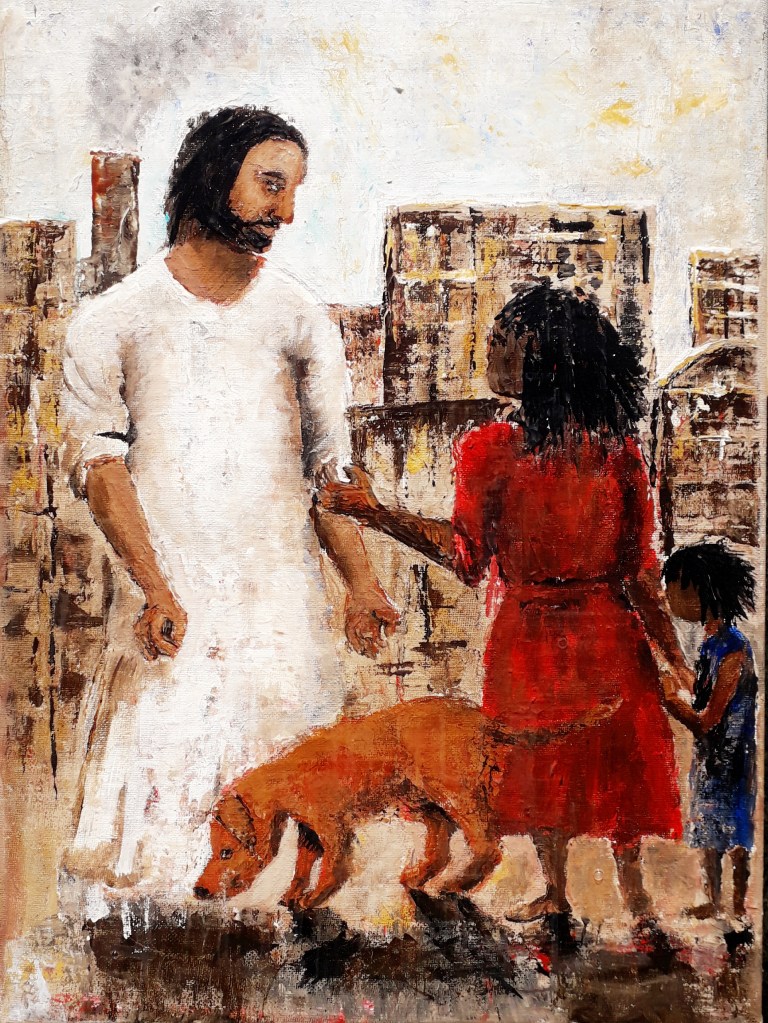
And behold, a Canaanite woman from that region came out and was crying, “Have mercy on me, O Lord, Son of David: my daughter is severely oppressed by a demon.”
[Matthew 15:22]
This story is terrible. At least, it seems that way at first. A poor foreign woman comes to Jesus, begging Him to heal her daughter, and He ignores her, calls her a dog and publicly humiliates her. If this was the only story you ever heard about Jesus, would you want anything to do with Him? There has to be more to the story, right? This doesn’t sound at all like the Jesus we’ve encountered in the gospels so far—the Jesus who cared deeply for the poor and the left out, the Jesus we saw talking with a cast-off woman sitting by a well.
On the surface, Jesus was having a conversation with a Canaanite woman, and He was testing her. But Jesus’ disciples were there too, and Jesus was very intentionally addressing them. In both cases, Jesus was at work to reveal what was in their hearts. Matthew tells us that this story takes place in the district of Tyre and Sidon. This was the land of the Gentiles. Historically, the people of this region were the enemies of Israel and the disciples had likely spent their whole lives avoiding and despising them. Not only were the disciples born into a culture that hated Gentiles, they grew up with a pretty low view of women as well. As Jesus was speaking to the woman, He was uncovering a root of prejudice in His disciples’ hearts.
We know the disciples weren’t wild about Jesus’ interactions with the woman because their advice to Jesus was to, “send her away.” It was as if they were saying, “Ugh, this worthless Canaanite woman is getting on our last nerve, Jesus, get rid of her!” Recognizing what was going on in their hearts, Jesus took the opportunity to essentially give them what they were asking for by showing them just how ugly it was when their prejudices were lived out against this woman. He gave an exaggerated response in order to get the disciples’ attention and show them just where their biases would lead.
First, He did what any respectable Rabbi would do when a filthy foreign woman approached him in public—He ignored her. Next, He answered with the expected cultural response—the Savior is only coming to save the Jews, the Canaanites aren’t worth saving. Finally, He called her a little dog, a phrase that had likely been directed at her from the mouths of Jews all her life.
Throughout the conversation, Jesus was testing the woman’s faith. And the woman came through like a champ. She didn’t react to Jesus or get insulted and walk away. She simply begged Jesus to be merciful. She was desperate for His mercy, and willing to pay any price to receive it, even public humiliation. She accepted His statement that she didn’t deserve His mercy. And yet, she stood, somehow convinced that He was merciful. Verse 28 reveals Jesus’ true heart toward the woman. He speaks to her with tender compassion and heals her daughter.
And He could have healed her daughter without putting her through all of that. So, why did He do it? On one hand, by highlighting the painful prejudice that she had faced her whole life, He was condemning it. He acknowledged and gave words to the ugliness so that He could call it out and heal her. Also, He dignified the woman by showing His disciples and all those who would hear her story what was in her heart. Here was a woman who truly understood what it looked like to cry out to a merciful God. She didn’t cry out based on her own merit, because of who she was or what she had done. She knew she didn’t deserve it, but she was desperately in need. She cried out based on Jesus’ mercy alone.
It’s easy to imagine the disciples falling in line behind Jesus with their heads slumped a bit. And not because Jesus was trying to shame them, but because they couldn’t help but confront the darkness in their own hearts. Somehow, they had been convinced that they were more deserving of Jesus’ life-giving mercy than this woman was. They had believed the lie that access to salvation was something they inherited, something they deserved. They believed that they had the right to stay with Jesus while this woman should be run off. But Jesus was rewriting the narrative. He wanted them to know that the Kingdom of Heaven belongs to those who are willing to cry out with their whole hearts, “Lord, have mercy.”
Scripture Reference:
“And behold, a Canaanite woman from that region came out and was crying, “Have mercy on me, O Lord, Son of David; my daughter is severely oppressed by a demon.” But he did not answer her a word. And his disciples came and begged him, saying, “Send her away, for she is crying out after us.” He answered, “I was sent only to the lost sheep of the house of Israel.” But she came and knelt before him, saying, “Lord, help me.” And he answered, “It is not right to take the children’s bread and throw it to the dogs.” She said, “Yes, Lord, yet even the dogs eat the crumbs that fall from their masters’ table.” Then Jesus answered her, “O woman, great is your faith! Be it done for you as you desire.” And her daughter was healed instantly.” Matthew 15:22-28 ESV
Discussion Questions:
1. What assumptions or prejudices are you carrying? Who do you think is undeserving of mercy? Maybe someone who hurt you? Maybe there’s a prejudice toward a people group or a type of person who you’ve elevated yourself above?
2. The Canaanite woman had the faith to trust that Jesus was merciful even before He healed her daughter. What about you, do you give up as soon as the first discouragement comes or do you trust and take Jesus at His word?
3. The woman cried out, “Lord, have mercy”. That is a powerful plea for help. What is the cry of your heart you are believing the Lord for? Declare it so that others might pray and believe with you.